Refuse Derived Fuel Market Size, Share, Growth & Industry Analysis, By Source (Industrial Waste, Municipal Solid Waste, Commercial Waste), By End-Use (Cement Kilns, Power Plants, Combined Heat and Power (CHP) Plants), and Regional Analysis, 2024-2031
Refuse Derived Fuel Market: Global Share and Growth Trajectory
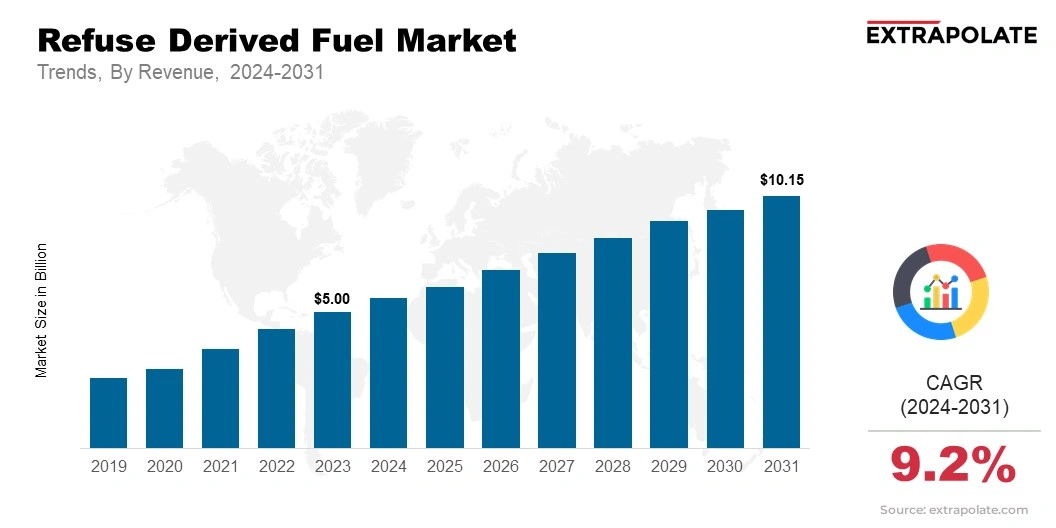
The global Refuse Derived Fuel Market size was valued at USD 5.00 billion in 2023 and is projected to grow from USD 5.50 billion in 2024 to USD 10.15 billion by 2031, exhibiting a CAGR of 9.2% during the forecast period.
The global market is experiencing significant growth, driven by rising concerns over environmental sustainability, advancements in waste management technologies, and a growing shift toward renewable energy sources.
This market encompasses various types of fuel produced from the non-recyclable waste materials, which are processed to generate energy in the form of heat or electricity.
As the demand for clean energy solutions grows, RDF is becoming an increasingly popular alternative to traditional fossil fuels, providing an eco-friendly way to manage waste and generate power.
The growing focus on reducing landfills and minimizing environmental pollution is fueling the demand for RDF. As urbanization increases and waste generation intensifies, municipalities and industries are seeking efficient ways to divert waste from landfills and repurpose it into valuable energy.
RDF plays a vital role in waste-to-energy initiatives, providing a dual benefit of waste reduction and energy production. This growing trend toward circular economy practices is driving the widespread adoption of RDF technologies worldwide.
Technological advancements in the RDF market are also contributing to its rapid expansion. Improved sorting, shredding, and processing techniques have enhanced the efficiency of RDF production, making it more cost-effective and environmentally friendly.
Additionally, advancements in combustion technologies, such as fluidized bed combustion and gasification, are enabling more efficient use of RDF in power plants, further increasing its appeal as an energy source.
As these technologies evolve, the potential for RDF to become a mainstream energy solution continues to grow, attracting investments and expanding the market.
The increasing emphasis on renewable energy and the transition away from fossil fuels is another key driver of the RDF market. Governments worldwide are implementing stricter regulations to limit carbon emissions, which is pushing industries to seek alternative energy sources. RDF, being a renewable and lower-carbon alternative to coal and other fossil fuels, is well-positioned to benefit from these regulatory changes.
Additionally, RDF is gaining traction as a cost-effective fuel in countries with limited access to traditional fossil fuels or where energy prices are high, further contributing to the market's growth.
As the world faces the challenges of waste management, energy sustainability, and climate change, the RDF market is expected to experience robust growth. With its ability to address both waste disposal and energy production needs, RDF is poised to become a crucial part of the global energy landscape.
The market's future growth is further supported by increasing investments in waste-to-energy infrastructure, expanding research into new RDF applications, and the rising demand for sustainable energy solutions across industries and regions.

Key Market Trends Driving Product Adoption
The Refuse Derived Fuel market is shaped by rapid advancements, increasing awareness of waste-to-energy solutions, and regulatory support. Key trends driving market growth include:
- Focus on Waste Management and Sustainability: Governments and industries are emphasizing waste management through RDF, reducing landfill usage and carbon footprints.
- Technological Advancements: Improved waste processing technologies are enhancing the efficiency of RDF production, enabling better resource utilization.
- Integration with Circular Economy Principles: RDF is playing a crucial role in circular economy models by converting waste into valuable energy resources.
- Industrial Use: RDF is getting used in industries such as cement and steel manufacturing as an alternative to conventional fossil fuels.
- Supportive Policies and Incentives: Subsidies and incentives for waste-to-energy projects are encouraging investments in RDF production and adoption.
Major Players and their Competitive Positioning
The Refuse Derived Fuel market is highly competitive, with leading players such as Veolia, SUEZ, Biffa, and FCC Environment driving innovation and capacity expansions. These companies are adopting advanced technologies and forming strategic partnerships to strengthen their market position.
Consumer Behaviour Analysis
Industries and municipalities are adopting RDF more frequently due to its economic and environmental benefits. These include reduced disposal costs and easier compliance with environmental regulations. End-users prioritize RDF because it provides consistent energy output. It is also adaptable to existing energy systems, making it a practical choice for many industries.
Pricing Trends
The price of RDF depends on factors like waste collection costs, processing technology, and local regulations. While RDF is cheaper than traditional fuels, setting up processing facilities requires a big initial investment. Government subsidies help make RDF more affordable. These financial incentives encourage its adoption across various industries and municipalities.
Growth Factors
Several factors are driving the growth of the RDF market:
- Rising Energy Demand: Rising global energy demand and shrinking fossil fuel reserves are driving the adoption of alternative fuels like RDF. This shift helps meet energy needs while reducing reliance on traditional fossil fuels.
- Stringent Environmental Regulations: Rules encouraging waste diversion from landfills and backing renewable energy are driving the growth of the market. These policies create incentives for adopting alternative fuels like RDF.
- Industrial Applications: Industries are utilising RDF as an energy source to reduce costs and meet sustainability goals. This shift supports both economic and environmental objectives.
- Technological Innovations: Sorting, shredding, and drying technologies are improving RDF quality. These upgrades make the process more efficient. They also make waste-to-energy cheaper.
Recent Developments
The RDF market is witnessing numerous developments, including:
- Expansion of RDF production facilities in regions like Europe and Asia-Pacific.
- Strategic collaborations between waste management firms and energy producers.
- Innovations in waste processing technologies, enhancing RDF quality and consistency.
Current and Potential Growth Implications
a. Demand-Supply Analysis
The demand for RDF is increasing steadily, supported by industrial requirements and government initiatives. However, limited infrastructure for waste collection and processing may pose challenges in some regions.
b. Gap Analysis
Despite significant progress, challenges remain:
- Limited awareness of RDF's benefits in emerging markets.
- High initial costs for setting up waste processing facilities.
- Variability in waste quality impacting RDF production consistency.
Top Companies in the Refuse Derived Fuel Market
- Veolia
- SUEZ
- Biffa
- FCC Environment
- Renewi
- Covanta Energy
- Sims Municipal Recycling
- Covanta
- Urbaser
- JFE Engineering
Refuse Derived Fuel Market: Report Snapshot
Segmentation | Details |
By Source | Industrial Waste, Municipal Solid Waste, Commercial Waste |
By End-Use | Cement Kilns, Power Plants, Combined Heat and Power (CHP) Plants |
By Region | North America, Europe, Asia-Pacific, Middle East & Africa, South America |
High Growth Segments
The following segments are expected to exhibit significant growth:
- Cement Kilns: The leading end-use segment due to its high energy requirements and compatibility with RDF.
- Municipal Solid Waste: An abundant and cost-effective source for RDF production.
Major Innovations
The RDF market is benefiting from innovations such as:
- Advanced sorting and processing technologies for improved RDF quality.
- Integration of IoT and AI for waste monitoring and management.
- Development of efficient RDF burners for use in industries.
Potential Growth Opportunities
Even with its growth, the RDF market faces challenges like:
- Limited waste management infrastructure in emerging regions.
- High costs of advanced waste processing technologies.
- Regulatory inconsistencies across different regions.
Kings Research Says
The global RDF market is growing quickly. This growth is mainly because governments and industries are focusing more on waste-to-energy solutions. This helps them to meet energy demands and environmental goals.
ARE YOU SEEKING COMPREHENSIVE INSIGHT ON VARIOUS
MARKETS?
CONTACT OUR EXPERTS TODAY
Refuse Derived Fuel Market Size
- February-2025
- 182
- Global
- energy-and-power
Related Research
Organic Rankine Cycle Market Size, Share, Growth & Industry Analysis, By Application (Solar Thermal
February-2023
Air Electrode Battery Market Size, Share, Growth & Industry Analysis, By Product (Zinc-Air Batteries
September-2024
Battery Recycling Market Size, Share, Growth & Industry Analysis, By Battery Chemistry (Lead-Acid, L
August-2025
Biodiesel Market By Feedstock (Soybean, Rapeseed, Palm, Palm, Poultry, Tallow, White Grease, and Oth
January-2023
Biomass Boiler Market Size, Share, Growth & Industry Analysis, By Product Type (Fully Automated Boil
August-2025
Biomass Power Generation Market Size, Share, Growth & Industry Analysis, By Feedstock (Woody Biomass
August-2025
Biomethane Market by Application (Automotive, Power Generation, and Others), Production Method (Ferm
February-2023
Cable Entry Systems and Components Market Size, Share, Growth & Industry Analysis, By Product Type (
February-2025
Carbon Capture and Storage Market Size, Share, and COVID-19 Impact Analysis, By Capture Source (Chem
August-2025
Diesel Market Size, Share, Growth & Industry Analysis, By Application (Transportation (On-road, Off-
April-2025