Natural Language Processing Market Size, Share, Growth & Industry Analysis, By Component (Solutions, Services) By Deployment (Cloud-based, On-Premises) By Technology (Machine Learning, Rule-Based, Hybrid) By Application (Text Classification, Sentiment Analysis, Machine Translation, Information Extraction, Question Answering, Others) By End-User (BFSI, Healthcare, Retail & E-commerce, IT & Telecom, Media & Entertainment, Government, Others), and Regional Analysis, 2024-2031
Natural Language Processing Market: Global Share and Growth Trajectory
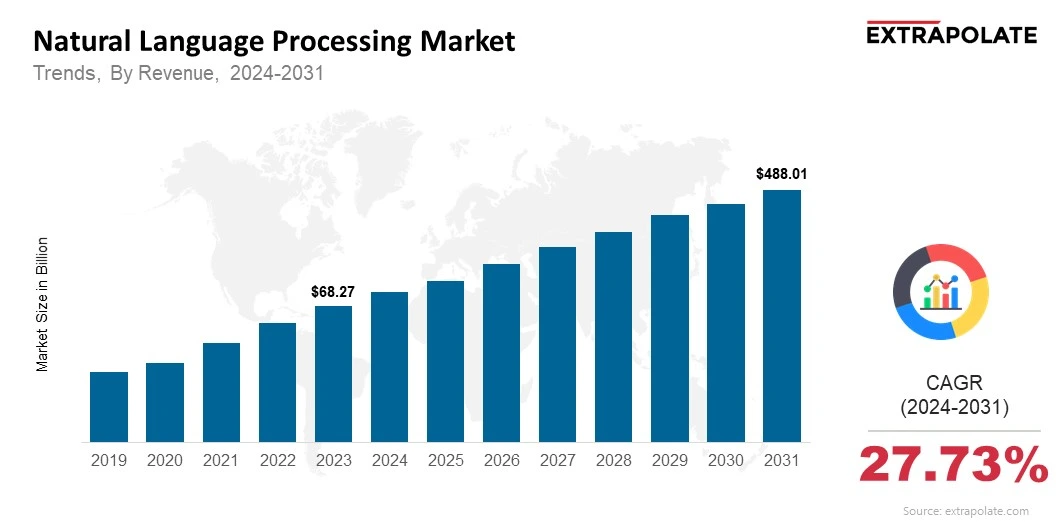
Global Natural Language Processing Market size was recorded at USD 68.27 billion in 2023, which is estimated to be valued at USD 87.95 billion in 2024 and reach USD 488.01 billion by 2031, growing at a CAGR of 27.73% during the forecast period.
The global Natural Language Processing (NLP) market is growing rapidly as data expands exponentially, digital transformation happens everywhere and AI is being integrated across industries. NLP, the field of artificial intelligence that enables machines to understand and respond to human language, is becoming the foundation of business intelligence, customer service, healthcare, finance and more. From real-time translation to intelligent voice assistants and sentiment analysis, NLP solutions are helping organizations get insights from text and speech data.
This growth is driven by the rapid digitization of communication channels, increasing demand for automation and the growing importance of human-machine interaction. NLP technologies are evolving fast, now with deep learning, transformer models like BERT and GPT and multimodal AI. As language models get more sophisticated, businesses are using them for contextual understanding, faster decision making and better customer engagement – driving the global NLP market forward.

Key Market Trends Driving Product Adoption
Several key trends are driving NLP adoption:
Conversational AI and Chatbots: Conversational AI is changing customer engagement. Organizations are deploying intelligent chatbots and virtual assistants to handle customer queries, automate responses and deliver personalized experiences across channels. NLP underpins these solutions, enabling nuanced understanding of language, context and user intent. As businesses prioritize 24/7 digital support, the reliance on NLP-powered conversation tools is growing fast.
Deep Learning and Transformer Architectures: Technological breakthroughs, particularly the arrival of transformer models like BERT, RoBERTa and GPT have dramatically improved NLP accuracy and contextual comprehension. These models allow for richer language representations and more human-like responses. This is turning NLP into a critical tool for applications from sentiment analysis to document summarization and content moderation.
Text and Speech Data Explosion: With the massive amount of user generated content, customer feedback, call center transcripts and social media interactions, organizations are looking for automated ways to get insights. NLP enables scalable and real-time analysis of unstructured data, helping businesses detect trends, improve services and drive customer centric strategies.
Language Localization and Globalization: As companies go global, the need to communicate in multiple languages is increasing. NLP supports multilingual content translation, localization and accessibility – making it a key enabler for global customer experience strategies and cross-border compliance.
Major Players and their Competitive Positioning
The NLP market is getting crowded with tech giants and specialized AI companies racing to innovate and win. Companies offer end-to-end NLP solutions, cloud-based APIs or industry specific applications: Google LLC, Microsoft Corporation, Amazon Web Services (AWS), IBM Corporation, Meta Platforms Inc., Apple Inc., Baidu Inc., SAP SE, Oracle Corporation, SAS Institute Inc.
These companies are investing in product development, AI research and strategic acquisitions. For example Google and OpenAI are making progress with large scale transformer models, while AWS and Microsoft Azure are expanding their NLP toolkits for developers and enterprises.
Consumer Behavior Analysis
End users of NLP technologies - from businesses to individual consumers - are showing increased interest driven by several behavioral shifts:
Automation and Speed: Businesses are looking for tools that can automate repetitive tasks such as email classification, document processing and support ticket routing. NLP automation offers time saving, accuracy and scalability benefits that match consumer expectations for fast service delivery.
Personalization: Consumers expect brands to know them and communicate contextually. NLP enables sentiment analysis and customer intent recognition, fuelling hyper personalization and product recommendations. This behavioral shift is pushing companies to embed NLP into their customer experience platforms.
Voice Interfaces: The popularity of voice assistants like Alexa, Siri and Google Assistant is changing user behavior. More people are using speech to text and voice search in their daily lives and businesses are responding by integrating NLP into voice enabled applications.
Trust in AI Insights: As NLP tools get more accurate and explainable, user confidence in AI insights is growing. Professionals in healthcare, law and finance are using NLP to analyze documents, flag anomalies and ensure compliance, and this is driving broader adoption.
Pricing Trends
NLP pricing varies by deployment model (cloud vs on-premises), complexity and scale. Open source libraries (e.g. spaCy, Hugging Face Transformers) offer an entry point, but enterprise grade tools often involve subscription based models, API usage fees or custom licensing.
Cloud NLP APIs from providers like Google Cloud, AWS and Azure are billed per character, word or transaction volume. These pricing models make NLP accessible to businesses of all sizes, from startups to large enterprises. And advances in hardware and edge computing are reducing computational costs, making real time NLP more cost effective than ever.
Vendors are also bundling NLP into broader AI and analytics platforms, offering customers value added services like speech analytics, knowledge management and document automation - all at competitive rate.
Growth Factors
Multiple factors are catalyzing the expansion of the NLP market:
Proliferation of AI and Digital Transformation: Organizations are investing in AI powered transformation strategies. NLP is a key component to unlock the value of unstructured text and voice data and automate and predict across departments.
Widespread Use of Smartphones and Smart Devices: Global smartphone and smart home device penetration has accelerated the use of NLP powered applications like voice assistants, translation apps and dictation tools. This ubiquity is expanding the NLP user base exponentially.
Regulatory Compliance and Risk Management: In industries like healthcare, law and banking NLP is playing a growing role in regulatory compliance - extracting key clauses from contracts, identifying sensitive information and flagging risks. This critical utility is driving adoption among compliance conscious industries.
Increased Investment in R&D and AI Startups: Governments, universities and corporations are investing heavily in NLP research. Funding for AI startups focused on language technologies is booming, making for a vibrant ecosystem that speeds up innovation and deployment.
Regulatory Landscape
The NLP market is in a regulatory landscape that is still evolving, especially around data privacy, algorithmic transparency and AI ethics. Some key considerations are:
Data Privacy Regulations: NLP systems that process personal or sensitive data must comply with regulations like GDPR, CCPA and India’s Digital Personal Data Protection Act. These frameworks require data anonymization, consent management and explainability in automated decision making.
Ethical AI and Bias Mitigation: Governments and organizations are under pressure to ensure NLP models don’t propagate biases around race, gender or language. There is increasing scrutiny around training data, fairness audits and responsible AI practices in NLP deployments.
Language and Accessibility Standards: In public facing applications NLP tools must comply with accessibility and language inclusion guidelines, especially in multilingual markets. Ensuring accurate translations and content moderation is key to regulatory and reputational compliance.
Recent Developments
Several recent developments reflect the accelerating pace of innovation in the NLP sector:
- New Language Models: OpenAI’s GPT-4, Meta’s LLaMA and Google’s Gemini are pushing the limits of NLP. These models are super fluent, super smart and multilingual, changing the way businesses interact with content and customers.
- Enterprise adoption of Generative AI: Companies are embedding generative NLP models into CRMs, document workflows and knowledge management systems. This is making operations more efficient and employees can create content, answer questions and synthesize reports in seconds.
- Multilingual and Low-Resource Language Models: New models are being trained on underrepresented languages to support NLP in emerging markets. Tools like BLOOM and mT5 are making language more inclusive and opening up new opportunities for global growth.
- Mergers, Acquisitions and Partnerships: Big tech companies are acquiring NLP startups or partnering with AI innovators to boost their language AI capabilities. For example, Microsoft’s partnership with OpenAI has added NLP to Microsoft 365 Copilot.
Current and Potential Growth Implications
Demand-Supply Analysis: NLP demand is booming in healthcare, banking and e-commerce. While cloud based APIs are meeting most of the demand, there is a growing need for domain specific NLP applications and real time inference at the edge.
Gap Analysis: Despite growth, NLP adoption is facing barriers – lack of language diversity in training datasets, high compute costs and need for explainable AI. Bridging these gaps through innovation and regulatory guidance will be key to inclusive and sustainable growth.
Top Companies in the NLP Market
- Google LLC
- Microsoft Corporation
- Amazon Web Services (AWS)
- IBM Corporation
- Meta Platforms Inc.
- Apple Inc.
- SAP SE
- Oracle Corporation
- Baidu Inc.
- SAS Institute Inc.
These companies are pushing the boundaries of NLP through continual innovation, large-scale infrastructure, and strong research partnerships.
In April 2025, FlowChai launched a new AI-driven content platform leveraging advanced conversational interfaces. The platform is designed to generate SEO-optimized content for individuals, businesses, and agencies using proprietary language models and intuitive conversational prompts.
In March 2025, H2O.ai introduced Enterprise LLM Studio, a turn-key platform for fine‑tuning and deploying large language models. Built for business users, the studio simplifies the creation of domain-specific NLP models through an intuitive interface and Dell-integrated infrastructure.
Natural Language Processing Market: Report Snapshot
Segmentation | Details |
By Component | Solutions, Services |
By Deployment | Cloud-based, On-Premises |
By Technology | Machine Learning, Rule-Based, Hybrid |
By Application | Text Classification, Sentiment Analysis, Machine Translation, Information Extraction, Question Answering, Others |
By End-User | BFSI, Healthcare, Retail & E-commerce, IT & Telecom, Media & Entertainment, Government, Others |
By Region | North America, Europe, Asia-Pacific, Latin America, Middle East & Africa |
Natural Language Processing Market: High-Growth Segments
The following segments are expected to exhibit robust growth:
- Text Analytics and Sentiment Analysis: Firms want to track customer views in real time. This boosts demand for NLP tools for sentiment analysis.
- Healthcare NLP Applications: Healthcare is a fast-growing area for NLP. It helps with clinical notes and patient feedback analysis.
- Multilingual NLP Solutions: Non-English markets are growing fast. This drives demand for multilingual NLP tools in Asia and Latin America.
Major Innovations
Key innovations in the NLP market include:
- Generative Language Models: Generative NLP models create human-like text and summaries. They boost content creation and business productivity.
- Context-Aware and Explainable AI: New AI models give accurate answers with clear reasons. This is key for use in strict, rule-based industries.
- Edge NLP Processing: Light NLP models are made for phones and IoT devices. They allow fast, offline, and private language processing.
Natural Language Processing Market: Potential Growth Opportunities
Significant opportunities for future expansion include:
- Emerging Market Adoption: Asia, Africa, and Latin America are boosting digital growth. This will lead to NLP tools in local languages and sectors.
- Integration with Robotic Process Automation (RPA): NLP and RPA work together for smart automation. They help with tasks like claims, document checks, and HR onboarding.
- Voice-First Applications: Smart devices are now widely used. NLP supports voice-first apps in homes and industries.
Extrapolate Research says:
The NLP market is going to grow big and fast over the next few years. As digital interactions multiply the need for machines to understand human language in all its complexity becomes more and more pressing. Technological advancements – particularly in deep learning, large language models and multilingual – are opening up new opportunities across industries.
Driven by demand for intelligent automation, better customer experience and real-time data analysis NLP is becoming a fundamental part of the AI landscape. Those that invest in NLP early will gain a competitive advantage by turning unstructured data into strategic insight and seamless user experience.
ARE YOU SEEKING COMPREHENSIVE INSIGHT ON VARIOUS
MARKETS?
CONTACT OUR EXPERTS TODAY
Natural Language Processing Market Size
- July-2025
- 140
- Global
- Information-Technology-Communication-IoT
Related Research
2018-2023 Commercial Interior Design Market Size, Share & Trends Analysis Report By Application ( O
March-2021
2018-2023 Industrial Product Design Market Size, Share & Trends Analysis Report By Application ( Tr
March-2021
2D Animation Software Market Size, Share & Trends Analysis Report By Application (Construction Field
March-2021
2D Vision Measuring Systems Market Size, Share & Trends Analysis Report By Application ( Commercial
March-2021
360 Degree Feedback Software Market Size, Share & Trends Analysis Report By Application ( Corporatio
March-2021
3D and 4D Technology Market Size, Share & Trends Analysis Report By Application (Entertainment, Cons
March-2021
3D Animated Films Market Size, Share & Trends Analysis Report By Application ( Children, Adults, Oth
March-2021
3D CAD Design Software Market Size, Share & Trends Analysis Report By Application (Small Business, M
March-2021
3D CAD Software Market Size, Share & Trends Analysis Report By Application ( Manufacturing, Automo
March-2021
3D CAD Software Market Size, Share & Trends Analysis Report By Application (Manufacturing, Automotiv
March-2021